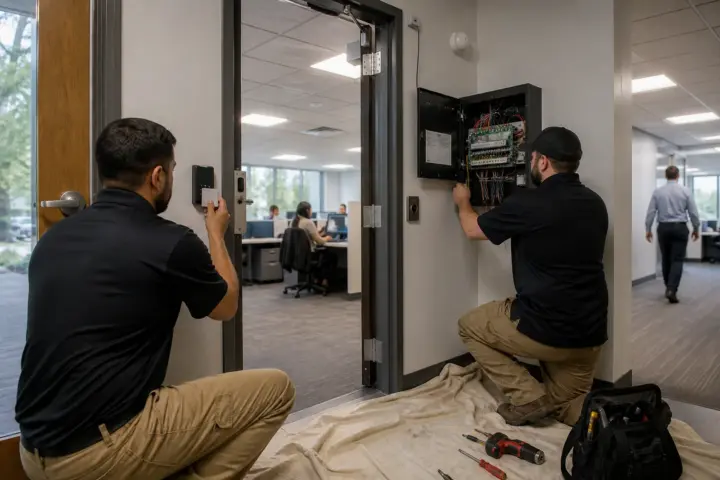
Businesses comparing access control systems in Grand Prairie need more than a reader count and a hardware brochure. A defensible plan connects each controlled opening to a real operating rule: who may enter, during which hours, through which door and what should happen when a credential is lost. That discipline is especially important for warehouses, light-industrial properties and distribution operations, where older doors must be evaluated before readers and electrified hardware are specified. The result should be a system the local team can run confidently after the installer leaves. Grand Prairie is a DFW logistics, distribution and manufacturing market with aerospace-related work, healthcare, entertainment, education, government and professional services. A useful mid-cities comparison tests those workflows and includes warehouse shifts and DFW service coverage.
Start the Grand Prairie building access design with a site survey
Begin with an opening-by-opening survey. Record the door and frame material, existing latch or panic hardware, traffic direction, nearby power, available cable routes and the way the opening must behave during an emergency. An exterior aluminum storefront door may need a different locking approach than a steel service door, an interior records room or a vehicle gate. Glass entrances, fire-rated assemblies and paired doors also deserve specific review. A qualified installer should explain the proposed electric strike, magnetic lock, electrified trim or wireless lock and identify any door repair that sits outside the access-control scope.
Access control planning in Grand Prairie often needs to address employee turnover, visitor traffic and the need to remove credentials promptly. A qualified installer should review the existing locks, frames, power, network paths and life-safety requirements before recommending readers or controllers. That survey determines where electrified hardware is practical and where a different door strategy may reduce installation cost or disruption. The same survey should document request-to-exit devices, door-position monitoring and the connection to life-safety systems where required. Access control regulates entry; it cannot obstruct required exit. The NFPA Life Safety Code is a useful national reference, while the adopted code and authority having jurisdiction determine the actual requirement for a Grand Prairie property. Quotes should state who coordinates permits, inspections, locksmith work and fire-alarm interfaces.
Compare cards, mobile credentials, key fobs and biometrics
Cards and key fobs remain practical when a business wants inexpensive credentials that are easy to issue and replace. Mobile credentials can reduce physical badge handling and support remote enrollment, although phone compatibility, Bluetooth behavior, app support and recurring credential fees belong in the comparison. PIN keypads can work for limited-use doors, but shared codes weaken accountability. Biometrics may fit selected high-security areas; they introduce enrollment, privacy and failure-mode questions that deserve more scrutiny than an ordinary staff entrance. The commercial access control systems guide explains how these options differ.
For many Grand Prairie facilities, mobile access control with encrypted smartphone credentials provide a practical balance of security and daily administration. The selected platform should make it simple to issue and revoke credentials, create schedules, review events and limit permissions by role or location. Buyers should also confirm data ownership, software terms, remote-support procedures and available exports. Permissions should follow job roles rather than being granted door by door without a standard. Define employee groups, contractor rules, visitor procedures and holiday schedules. A clear offboarding process can matter more than a flashy dashboard: an authorized Grand Prairie administrator should be able to remove access immediately and preserve the event history needed for review.
What should a Grand Prairie access control quote include?
Give every provider the same schedule of controlled doors, active users, credential quantities and integration requirements. Ask for reader, controller and locking-hardware model numbers; cabling and pathway assumptions; power supplies and backup; software hosting; licenses; training; warranty; permit allowances; travel; and any recurring support charge. If cameras, alarms, visitor management or HR systems are involved, require the proposal to name the supported integration and which company owns each part of the work. The access control buyer’s guide provides a practical checklist for building that scope.
Price comparisons become misleading when one proposal includes door preparation, network switches and five years of software while another shows hardware only. Normalize the term and the responsibilities before comparing totals. Ask how the system works during an internet interruption, what information remains available locally, how backups are handled and how data can be exported if the business changes providers. A written access control price request gives installers fewer reasons to substitute assumptions for actual scope.
Keep the Grand Prairie system useful as the business changes
A phased plan can secure priority doors first while preserving a clear path for additional entrances, buildings and credential types. In Grand Prairie, proposals should use the same controlled-door count and integration assumptions so hardware, labor, licensing and support can be compared fairly. Ask who provides local service in Grand Prairie, what remote diagnostics are available and how urgent door failures are prioritized. The business should know who holds administrator credentials, how software and controller firmware are updated, and whether remote access uses multifactor authentication. The CISA physical security resources can help frame broader risk questions, but the installed platform still needs documented account ownership and a clear support path.
Leave controller, license and network capacity for realistic growth rather than buying an unlimited design that the property will never use. Map likely next-phase doors and identify whether they can share existing panels or require new infrastructure. Businesses evaluating nearby markets can also review Abilene access control, Amarillo access control, Arlington access control. Within Grand Prairie, the strongest proposal is the one that explains present operation, expansion limits and total recurring cost in plain language. Use that common brief to compare qualified providers instead of choosing from a product name or a headline price alone.
Compare the same access control scope.
Describe the property, doors, people and integrations once.
Request Access Control Prices